Preschoolers are learning to pause an interesting activity, hold words in mind, understand what an adult means and move their body into action. Those skills are still developing. A child who keeps building after hearing “clean this mess and get ready” may not be choosing defiance; the instruction may be too broad, too long or delivered before the child’s attention shifted.
CDC’s updated 2026 parenting guidance recommends simple, specific, age-appropriate directions, one at a time. It also reminds adults that inability is not the same as disobedience. That distinction changes the response from shouting to teaching.
Why preschoolers appear not to listen
They are deeply focused
Play is real work for a young child. A direction called from another room may not break through concentration. Touch the floor beside them or move into their visual field instead of repeating from a distance.
The direction is vague
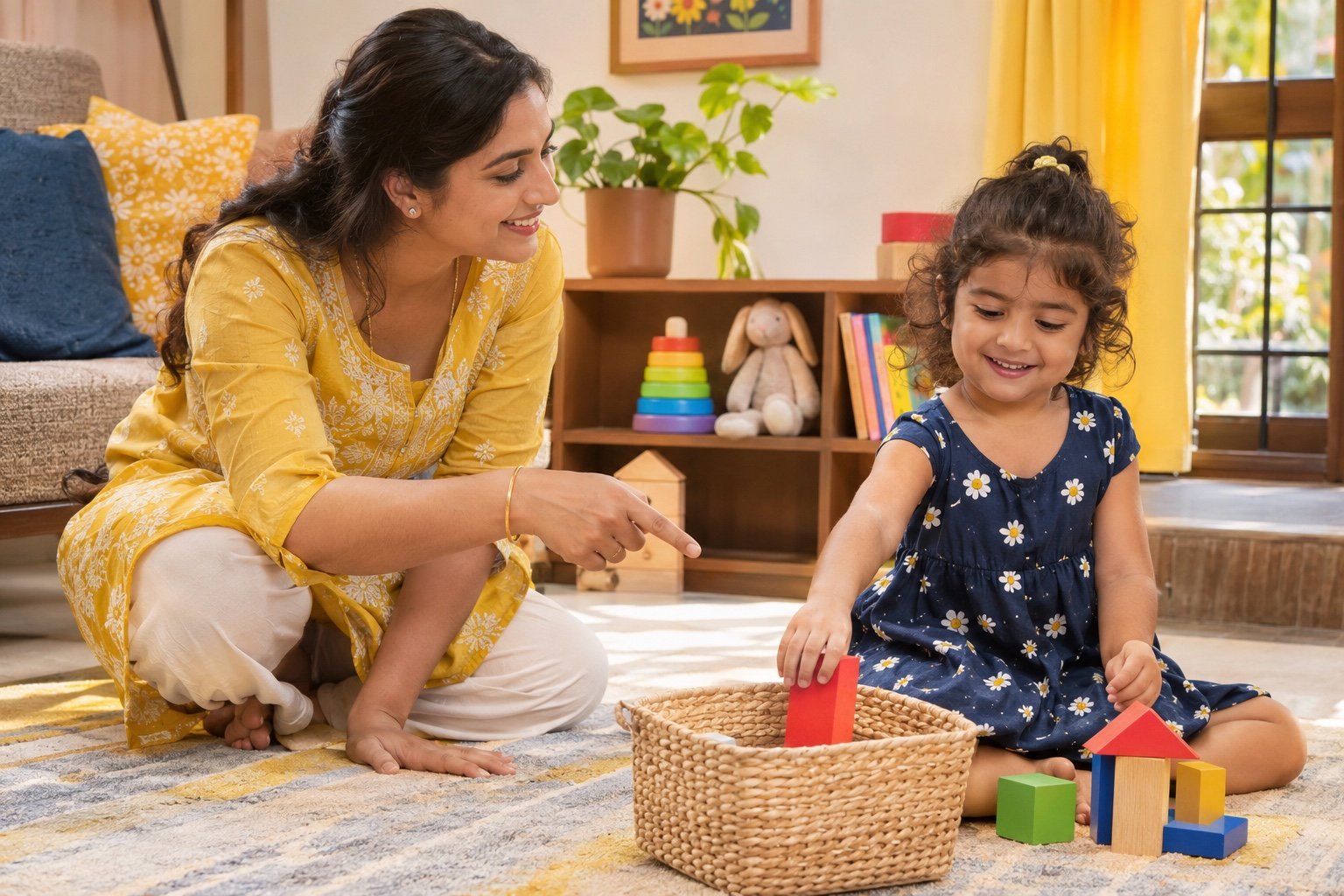
“Behave”, “be good” and “clean everything” do not describe the visible action you want. “Put the red blocks in this basket” gives the child a starting point.
There are too many steps
“Pack your bag, wear shoes, take your bottle and wait at the door” asks a preschooler to remember a sequence. Give one step, then the next. Use a picture routine for repeated mornings.
The child cannot yet do it alone
A three-year-old may understand “fold the blanket” but not have the coordination to do it neatly. Demonstrate, help with the first part or reduce the task.
A transition feels sudden
Stopping play instantly is hard. Give a useful preview: “Two more turns, then blocks go in the basket.” A timer or short clean-up song makes the ending predictable.
Body needs are getting in the way
Hunger, fatigue, illness, noise or a long day can reduce cooperation. Keep the boundary, but shorten the language and increase support.
The five-step clear-direction routine
- Get attention: move near, say the child’s name and wait for a sign they noticed you.
- Give one action: state what to do, not only what to stop. “Feet stay on the floor” is clearer than “Don’t climb.”
- Add a visual cue: point to the shoes, basket or handwashing area. Show the first movement if necessary.
- Pause briefly: allow processing time instead of filling every second with more words.
- Notice and follow through: describe cooperation specifically. If the child does not begin, repeat once and calmly provide the help or logical limit you said would follow.
A calm voice does not mean the request is optional. It means the adult is clear enough not to need a threat, lecture or rising volume.
Scripts that are easier to follow
Two acceptable choices support independence without changing the boundary. Both choices should work for the adult: yellow shirt or blue shirt, walking to the bathroom or hopping there.
Use praise that teaches
Specific feedback helps the child identify the useful behaviour: “You came when I called your name”, “You put the bottle in your bag” or “You stopped at the gate and held my hand”. A high-five, warm smile or short shared activity can reinforce cooperation without turning every task into a material reward.
Notice small starts. If the child puts away two blocks, acknowledge that step and guide the rest: “The blue blocks are in—now these three.” Do not let an eye roll erase the fact that the direction was followed.
A calmer school-morning sequence
- Prepare clothes and bag the night before.
- Show a three-picture routine: toilet, clothes, breakfast.
- Give one direction only after gaining attention.
- Offer a choice at one flexible point, not every step.
- Build ten buffer minutes so adults are less likely to shout.
- Keep the final goodbye routine short and predictable.
If mornings are difficult because bedtime is late, use our preschool sleep schedule guide. Behaviour support works better when the body is rested.
What usually makes listening harder
- Calling instructions repeatedly from another room.
- Giving several questions when the task is required.
- Changing the rule depending on the adult’s mood.
- Explaining for two minutes before the child knows the first action.
- Threatening a consequence that will not be followed.
- Using shame: “You never listen” or “Why can’t you be like your sister?”
- Expecting instant calm during a full emotional meltdown.
When a child is overwhelmed, protect safety and help regulation first. Teach the direction later using the calm sequence in our big-feelings guide.
Coordinate with the preschool teacher
Ask which cues work in class: a clean-up song, first–then language, a picture card or one-to-one reminder. Compare situations rather than labels. Does the child follow familiar one-step directions during play? Is difficulty greater in noisy groups, in one language or during transitions?
Use the same two phrases at home and school for a week. Consistency is more helpful than trying five new techniques each day.
When to request extra support
Not listening sometimes is expected. Speak with a paediatrician if a child often does not respond to their name or environmental sounds, seems to hear some sounds but not others, struggles to understand familiar one-step language across home and school, loses communication skills, or has difficulty that significantly affects safety and daily participation.
Ask about hearing and language assessment when relevant. Multilingual exposure does not equal disobedience; check understanding in the languages the child knows. Our speech and language guide explains what information to take to an appointment.
Quick parent FAQs
Why does my preschool child not listen?
They may be focused, tired, overwhelmed, unsure what a vague request means or unable to remember multiple steps. Get attention and check understanding before assuming deliberate refusal.
How do I help my child follow directions?
Move close, say the child’s name, give one specific action calmly, add a gesture, pause briefly and describe success. Use two acceptable choices when flexibility is possible.
When should we ask for professional advice?
Ask for advice if your child often does not respond to sound or name, struggles with familiar one-step language across settings, loses skills or has listening difficulties that affect safety or participation.