Parents hear “phonics” everywhere, but the word is often used for several different skills. Phonological awareness is the ability to hear and play with sounds in spoken language. Phonics connects those sounds with written letters or letter groups. Both sit alongside vocabulary, conversation, stories, comprehension and a love of books.
What the Indian foundational framework recommends
India’s National Curriculum Framework for the Foundational Stage places phonological awareness before and alongside explicit letter–sound instruction. It also keeps meaning at the centre: children meet letters within useful words, stories, read-alouds, shared reading and conversation—not as isolated drills only.
For multilingual children, strong home-language conversation is an asset. You do not need to stop Hindi, Rajasthani or another family language to support English phonics. Rich talk, songs and stories in familiar languages build listening, vocabulary and confidence.
A realistic 10-minute routine
- Two minutes—listen: clap syllables in two names or find words that rhyme.
- Two minutes—focus sound: clearly say one sound and show how the mouth moves.
- Three minutes—object hunt: find two or three things beginning with that sound.
- Two minutes—connect the letter: show the printed letter and trace it with a finger in the air.
- One minute—finish with success: reread a favourite page, sing or let the child choose the final word.
This is a menu, not a test. A three-year-old may spend the whole time on listening and rhyme. A five-year-old who is ready may blend two or three sounds into a simple word with teacher guidance.
Eight phonics games using things at home
1. Sound basket
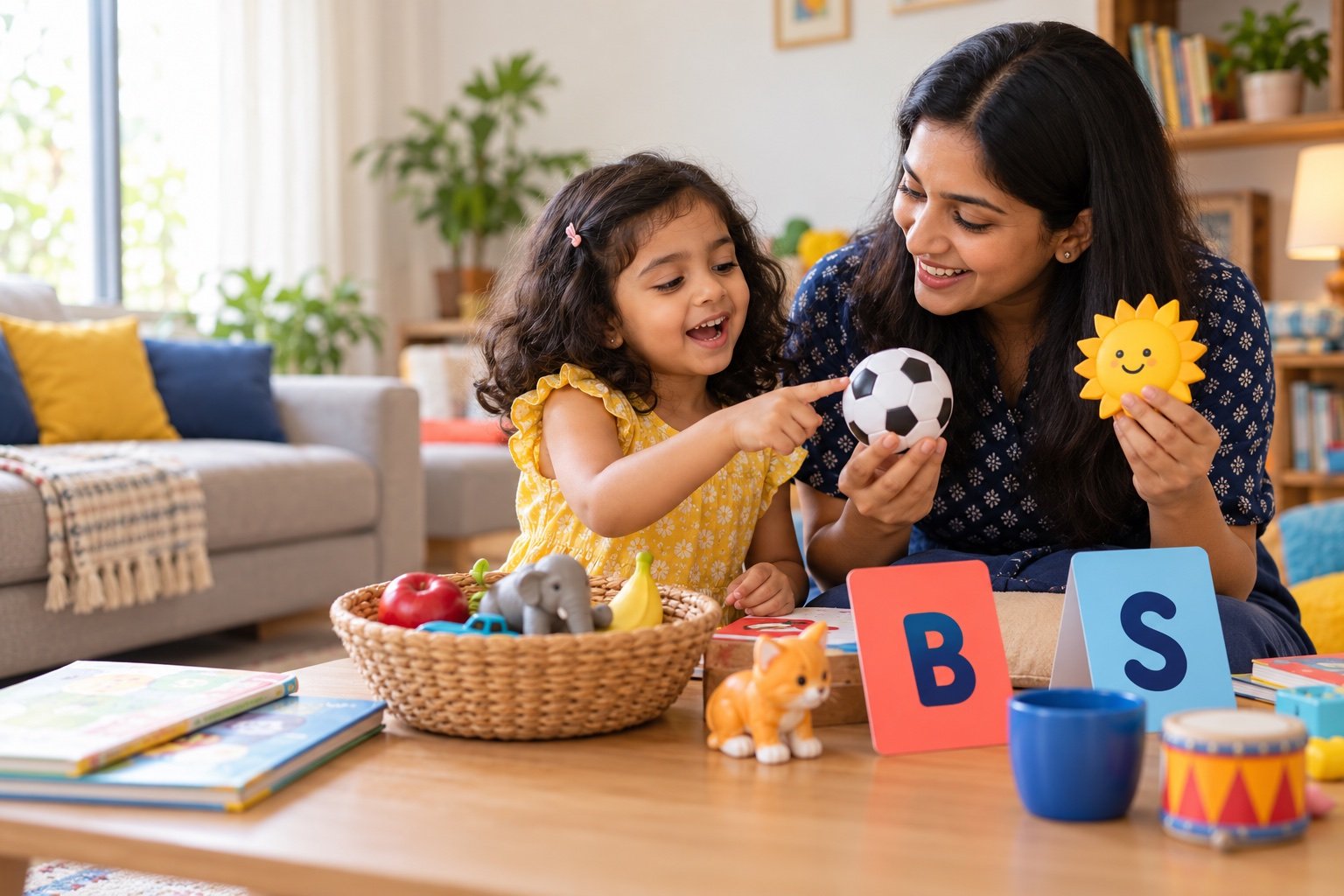
Collect three safe objects, such as a ball, spoon and toy car. Ask, “Which one begins with /b/?” Keep the number small enough for success.
2. First-sound detective
During breakfast, find two words beginning with the same sound. Say the sound cleanly—/m/, not “muh”—so later blending is easier.
3. Silly sound train
Take turns adding words with the same beginning sound: sun, sock, soap. Invented silly words are fine when the goal is listening.
4. Rhyme or not?
Say two words—cat/hat or cat/cup—and let the child show thumbs up when they rhyme. Use words your child understands.
5. Sound walk
Choose one sound before a walk or car ride and spot objects that begin with it. Do not correct every answer; repeat the word slowly and compare.
6. Toy-talk blending
A puppet says a word in parts—/s/ /u/ /n/—and the child guesses “sun”. Start with easy, short words and stretch sounds that can be held.
7. Letter parking
Place two large letter cards on the floor. Drive a toy car carrying an object to its matching beginning sound.
8. Picture-book sound hunt
After enjoying the story, return to one page and look for a chosen letter or sound. Story meaning comes first; the hunt is a tiny extra.
Which sounds should parents teach first?
Follow the preschool’s sequence when possible so the child receives consistent modelling. A good sequence usually selects useful sounds that can soon combine into meaningful words rather than simply moving from A to Z. Do not introduce many new sounds in one sitting.
Ask the teacher how each sound is pronounced, which action or story cue the class uses and whether children are blending yet. This avoids teaching a conflicting cue at home.
Letter names, sounds and writing
Children eventually need letter names and sounds. In a phonics moment, point to the symbol, model its sound and connect it to a meaningful word. Continue alphabet songs and everyday letter-name talk without turning every interaction into a quiz.
Writing can grow alongside sound play through drawing, paint, play-dough letters and mark-making. Use the fine-motor activity guide to strengthen hands without forcing pages of tracing.
Common mistakes that slow the fun
- Adding a heavy “uh” to consonants, which makes blending harder.
- Teaching too many sounds before the earlier ones are secure.
- Quizzing continuously: “What is this? You know this!”
- Using only flashcards and worksheets without stories or conversation.
- Correcting accent or home-language influence in a way that embarrasses the child.
- Expecting a preschooler to read independently before they are developmentally ready.
- Comparing siblings or classmates.
What progress can look like
Progress is not only reading a word. Notice when your child enjoys rhymes, hears the first sound in their name, spots a familiar letter, blends two sounds with help, retells a story or asks what a sign says. These are meaningful early-literacy behaviours.
If the child guesses from pictures, acknowledge the meaning and then model the sound strategy: “The picture does show a dog. Let’s also look at the first letter—/d/.” Phonics and comprehension work together.
When the child resists
Stop before the activity becomes a battle. Return to songs, read-alouds and playful listening. Try at a better time of day and shorten the task. A five-minute positive experience repeated during the week is more useful than one long, pressured session.
Speak with the teacher if your child consistently cannot hear differences between sounds, struggles to understand spoken language, avoids all books or becomes distressed. A paediatrician, audiologist or speech-language professional can advise when there are concerns about hearing, speech or language. This article is educational guidance, not an assessment.
A simple weekly plan
Keep phonics inside a wider play-based learning routine with movement, art, conversation and pretend play.
Quick parent FAQs
What age should a child start phonics?
There is no single starting age. Many children aged 3–5 enjoy oral sound games, rhymes and gentle letter–sound play when interested. Coordinate with the teacher and avoid rushing through a formal programme.
Should I teach letter names or sounds first?
Children need both. During phonics, connect the sound to a visible letter and a meaningful word while continuing songs, stories and everyday use of letter names.
How long should practice be?
Five to ten playful minutes is enough for many preschoolers. Stop while your child is still engaged. Reading aloud, conversation, songs and free play remain essential.