
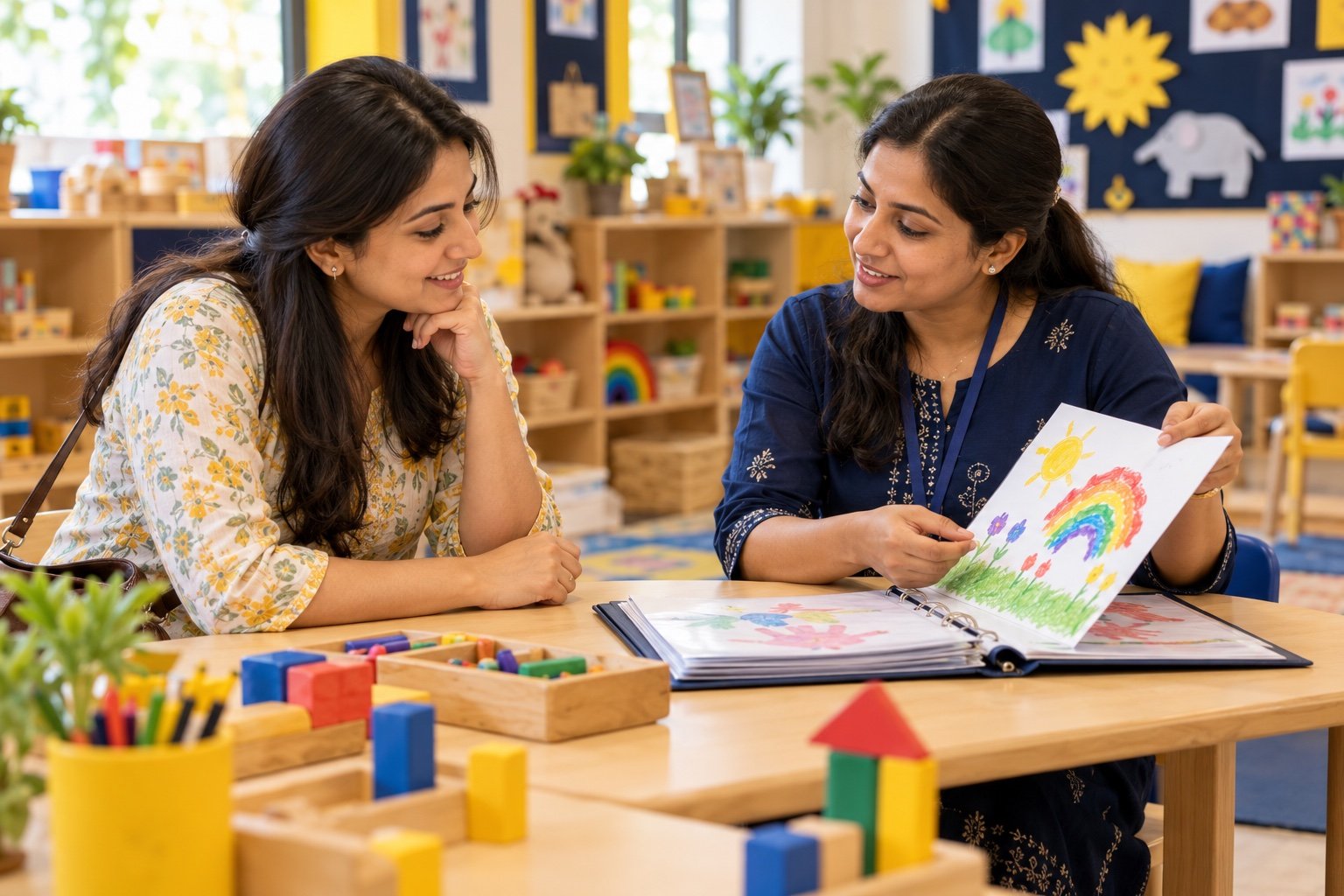
A preschool parent–teacher meeting is not a report-card verdict. It is a short conversation between two people who see the child in different settings. Parents know home routines, interests and recent changes; teachers observe group play, transitions, communication and independence. The best PTM connects those two pictures.
Before the meeting: prepare in five minutes
- Write down one thing your child enjoys about school and one thing that seems difficult.
- Note recent changes in sleep, health, family routine or caregiving that may affect behaviour.
- Ask your child a neutral prompt: “What do you like to do after you reach class?”
- Choose your top three questions and keep space to note the answers.
- Ask whether your child should attend; sensitive topics may need a private conversation.
Settling in and emotional comfort
- How does my child usually settle after I leave?
- Which person, activity or routine helps them feel comfortable?
- Are there particular transitions—arrival, cleanup, toilet time or goodbye—that feel difficult?
- How does my child show you they need help or comfort?
- What is one confidence-building routine we can use both at home and school?
Ask for an example from a recent day. “She settles well” is reassuring; “she cries for two minutes, then joins the puzzle table when Ma’am invites her” gives you a routine you can reinforce.
Friendships and social behaviour
- Does my child mostly play alone, beside other children or together with them?
- Who or what do they naturally approach during free play?
- How do they handle sharing, waiting and turn-taking?
- What happens when there is a disagreement?
- Is there a social skill we can practise through play at home?
Preschoolers are still learning social language and self-control. Avoid asking, “Is my child naughty?” Ask what happened before, during and after a behaviour. Context turns a label into something adults can understand and support.
Communication and participation
- How does my child communicate needs such as water, toilet or a break?
- Do they speak differently in a group, one-to-one and at home?
- Do they listen to and follow simple classroom directions?
- Which songs, stories or conversations engage them most?
- Are there words, gestures or home-language details that would help the teacher understand them better?
Play, curiosity and early learning
- Which activities does my child choose without prompting?
- What have you noticed they are curious about right now?
- How do they respond when an activity feels challenging?
- Can you show me one piece of work or observation that reflects their progress?
- What simple play experience at home would extend what the class is exploring?
In the early years, progress is broader than worksheets. Look for growing attention, imagination, language, coordination, problem-solving and willingness to try—not only whether the page looks neat.
Independence, routines and the next step
- Which daily tasks can my child manage independently?
- Where do they still need reminders or physical help?
- What is one strength you have noticed that I may not see at home?
- What is one realistic shared goal for the next four to six weeks?
- How and when should we check progress together?
How to discuss a concern without creating conflict
Begin with observation rather than accusation: “At home, Aarav says loud group time feels difficult. What do you notice in class?” Ask how often it happens, what seems to trigger it and what has already helped. Then share what works at home.
If the topic needs more time, book a follow-up rather than forcing a conclusion in the last two minutes. The American Academy of Pediatrics recommends preparing questions and arranging additional time when a regular conference is too short. A preschool teacher can share observations but should not be pressured to diagnose a child.
Questions that usually do not help
- “Is my child the smartest in the class?”
- “Why can another child do this but mine cannot?”
- “Who is the naughty child causing problems?”
- “Can you make sure my child is always first?”
- “Everything is fine, right?” asked without inviting honest detail.
Comparison can close the conversation. Ask about your child’s pattern, progress and next achievable step instead.
Leave with a three-part action note
End by repeating the plan in your own words: “We will practise asking for a turn at home, you will use the same phrase in class, and we will check in after three weeks.” This prevents a good conversation from disappearing into a busy week.
If settling is the main concern, read our calm preschool drop-off guide. For age-appropriate expectations, use the preschool readiness checklist.
Quick parent FAQs
What should I ask at a preschool PTM?
Ask for specific examples of how your child settles, communicates, plays with peers, joins activities and manages daily routines. Finish by agreeing on one shared goal and a follow-up date.
Should I discuss concerns in front of my child?
Ask the teacher in advance whether the child should attend. Sensitive concerns are usually better discussed privately and respectfully, without labelling or comparing the child.
How do I prepare for a parent–teacher meeting?
Note two observations from home, choose your three most important questions, share relevant routine changes and carry a way to record the agreed next steps.