When a preschooler says something clearly untrue, adults may worry about character: “Will my child become dishonest?” At ages three to five, however, children are still learning that other people do not automatically know what they know. They are also developing memory, impulse control, imagination and an understanding of consequences. One untrue sentence does not define an untrustworthy child.
The useful question is not simply, “Was that a lie?” Ask what job the story is doing. Is it playful make-believe? A wish? A confused memory? An attempt to avoid anger? Or a repeated, deliberate pattern that needs more support? Different causes need different responses.
Truth, imagination or avoidance?
Imaginative tall tale
“I flew to the moon last night” is often creative play, not an attempt to cheat anyone. Join briefly—“What did you see?”—then mark the boundary: “That is a wonderful pretend story. Now tell me what really happened before bed.” The words pretend and real help a child sort categories without crushing imagination.
Wish stated as fact
“Papa said I can have chocolate” may mean “I really want chocolate.” Reflect the wish and keep the rule: “You wish Papa had said yes. I will check with him.” Do not reward the claim simply to avoid a scene.
Mistake-hiding
A child who knocked over milk may instantly say, “Not me.” Fear often speaks before reflection. If adults shout over accidents, denial becomes a protective shortcut. Calm repair makes the truth less frightening.
Memory or language gap
Young children can mix the order of events, repeat a friend’s story as their own or answer the question they think an adult wants. Fatigue and leading questions increase confusion. One calm prompt and time to answer are more reliable than repeated interrogation.
Four common moments—and better scripts
Notice the pattern: truth earns appreciation, but it does not erase every natural consequence. If admitting a broken toy always removes responsibility, the child may learn that “sorry” is a way out. Repair teaches accountability without humiliation.
Make truth safer to tell
- Regulate your face and voice. A child watches your reaction before choosing the next sentence.
- State what you know. If you saw the crayon mark, do not ask, “Did you draw on the wall?” Say, “I see fresh crayon on the wall.”
- Invite a redo. “That answer is not matching what I saw. Take a breath and try the true story.”
- Separate honesty from repair. Appreciate the truth, then clean, return or apologise together.
- Keep consequences related. If blocks were thrown, blocks pause while everyone checks safety. Avoid unrelated threats about birthday parties or love.
- Practise outside conflict. Sort silly examples into “real” and “pretend”, tell stories with puppets and model correcting yourself.
Children learn honesty in thousands of small interactions. The aim is not to catch every false statement; it is to create a family culture where reality can be spoken and mistakes can be repaired.
What usually makes lying worse
- Asking the same question again and again until the child changes the answer.
- Using shame, sarcasm or labels such as “liar” and “bad child”.
- Setting an impossible trap when the adult already knows what happened.
- Giving very harsh punishment for an ordinary mistake.
- Laughing at convenient lies while punishing inconvenient ones.
- Making the child confess publicly in front of siblings, relatives or classmates.
- Expecting an exact adult-style timeline from a tired four-year-old.
If a child becomes overwhelmed, pause the investigation. Help the body settle, then return to one simple question. Our preschool big-feelings guide has co-regulation steps for moments when language is not available.
Model the honesty you want
Children notice when adults say, “Tell them I am not home” or invent an excuse for being late. Use age-appropriate honesty instead: “I made a mistake and forgot the appointment. I will apologise and reschedule.” If you wrongly accuse your child, repair openly: “I thought you moved it, but I was wrong. I am sorry.”
Also keep promises realistic. Instead of “I will come in five minutes” when it may take an hour, say, “I will come after I finish this call.” Trust grows when adult words match events.
Use stories and play to teach the difference
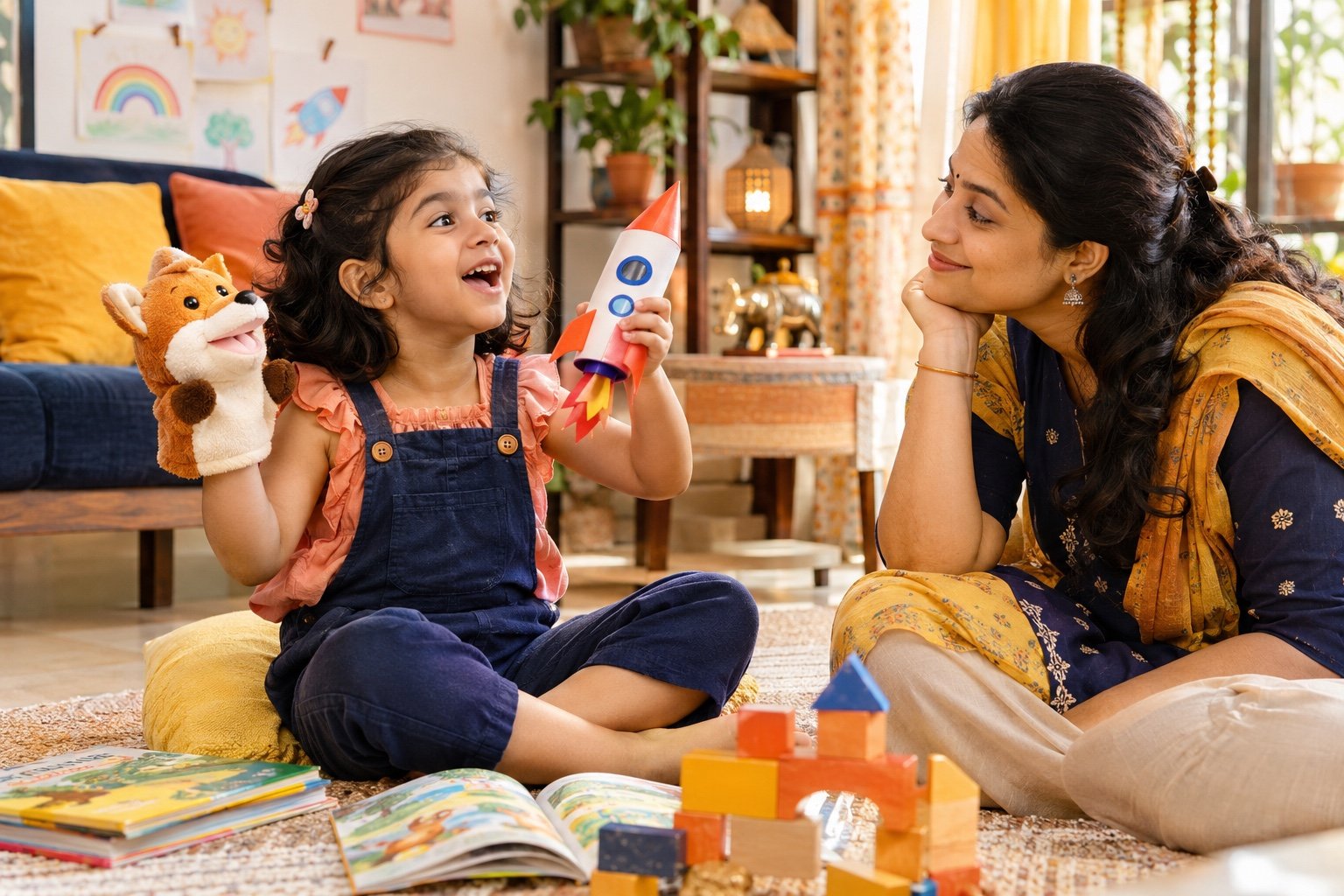
Preschoolers learn through concrete examples. Hold a toy banana and announce, “This is a telephone!” Ask, “Real or pretend?” Then describe something true: “The banana is yellow.” Picture books and puppet play let children explore mistakes without feeling accused.
Invite storytelling on purpose: “Now it is imagination time. Add the silliest animal you can.” Clear permission for fantasy helps children enjoy creativity while learning when adults need factual information. Strong language skills also make accurate explanations easier; see our speech and language milestones guide if expressing events is difficult.
When a child reports something serious
Never dismiss a report of harm, unsafe touch, bullying or fear simply because the child has told untrue stories before. Stay calm, listen without supplying details, record the child’s own words and seek appropriate professional or child-protection guidance. Avoid repeated questioning, which can increase stress and confusion.
A child can be imaginative in play and truthful about a serious event. Safety reports require a different response from a broken-crayon dispute.
When should parents seek extra help?
Occasional tall tales and denial are common in preschool years. Speak with a paediatrician or qualified child mental health professional when deception is frequent and serious across home and school, is used to harm or exploit others, involves stealing or unsafe behaviour, appears alongside major changes in mood, sleep, aggression or development, or does not improve with calm and consistent teaching.
Ask the preschool for observations, not labels: what happened before, exactly what the child said, how adults responded and what happened next. Patterns help professionals understand whether language, anxiety, impulse control, family stress or another need is involved.
A seven-day honesty reset
- Remove the word “liar” from family language.
- Use “real or pretend?” once a day during playful stories.
- Model one small honest correction of your own.
- When a mistake happens, state the evidence instead of setting a trap.
- Praise one truthful moment specifically.
- Use a related repair without a lecture.
- Compare the week: Is your child admitting things sooner and with less fear?
Consistency matters more than a perfect script. Calm truth-telling practice, clear boundaries and genuine repair help honesty become a skill—not a test of whether a preschooler is “good”.
Quick parent FAQs
Is it normal for a 4-year-old to lie?
Preschoolers may tell tall tales, mix wishes with reality or deny mistakes to avoid a reaction. Their social understanding and impulse control are developing. Name reality calmly and practise honesty.
What should I say when my preschooler lies?
State what you observed, invite a truthful redo and focus on repair: “The crayon is on the wall. Tell me what happened, then we will clean it together.” Avoid labels and interrogation.
When is lying in a young child concerning?
Seek guidance when it is frequent and serious across settings, harms others, involves unsafe situations or comes with major behaviour or emotional changes. Never dismiss a safety disclosure because of earlier tall tales.