Parents often compare notebooks at pickup: one child writes a full name, another makes circles and lines. That difference can create unnecessary pressure. Writing is not one isolated trick. It grows from language, drawing, visual attention, hand strength, coordination, memory and the understanding that marks can carry a message.
The CDC’s current four-year milestones include drawing a person with three or more body parts and holding a crayon or pencil between fingers and thumb rather than in a fist. The checklist does not require every four-year-old to write the alphabet or a perfectly formed name. Milestones describe what most children can do, not an exam every child must pass on a birthday.
What writing can look like at age four
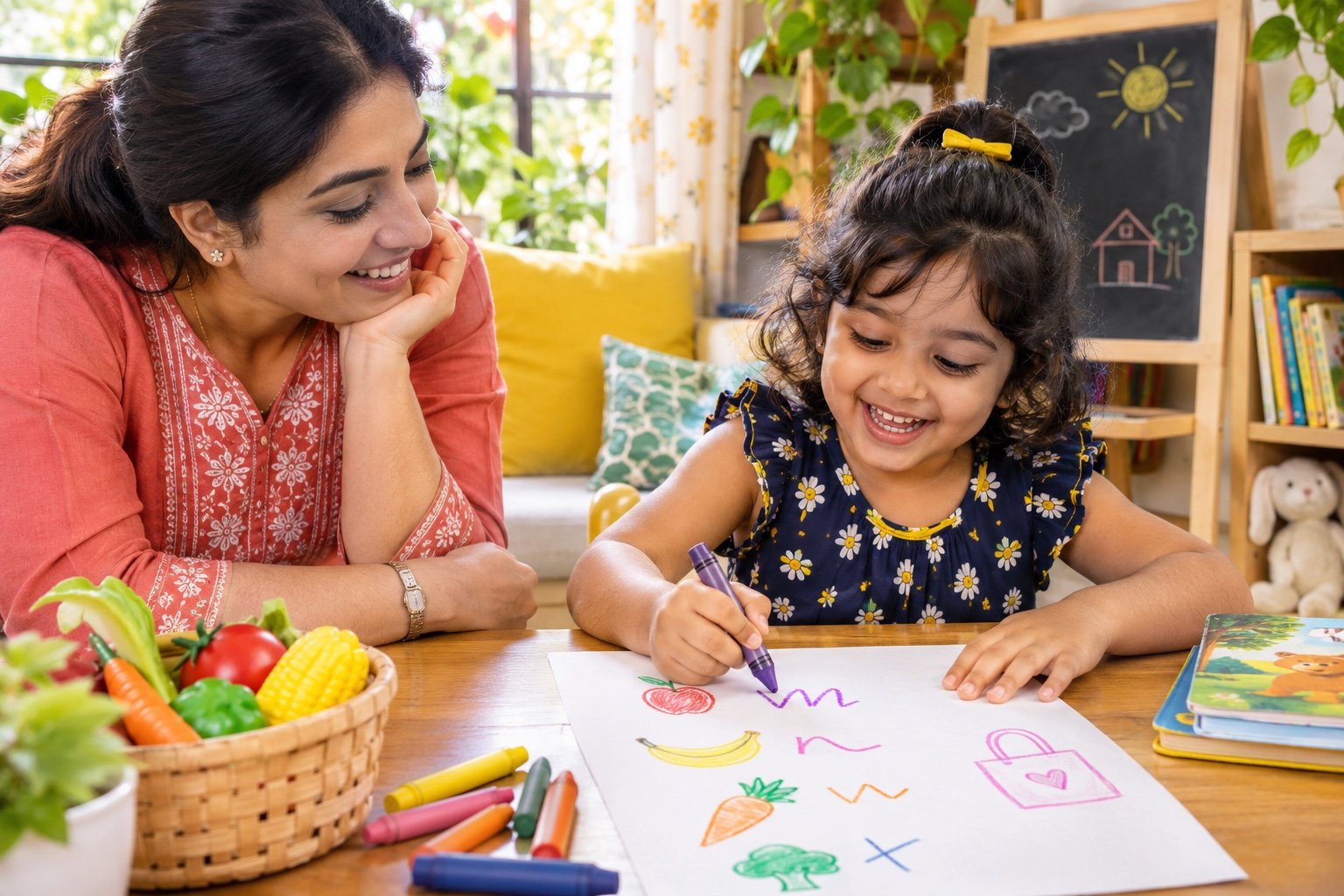
- Drawing people, homes, roads or favourite objects and explaining the picture.
- Making lines, curves, circles, crosses and other repeated shapes.
- Using letter-like symbols or a mix of recognisable and invented letters.
- Attempting the first letter or several letters of their name.
- Pretending to write a menu, doctor’s note, ticket or shopping list during play.
- Dictating a sentence while an adult writes it down.
- Copying a simple shape or familiar letter when interested.
Development is not a neat ladder. A child may draw detailed pictures but avoid letters, or recognise letters while still using a less mature grip. Interest also changes by context: a reluctant worksheet writer may happily create a “no dinosaurs” sign for a block castle.
Should my four-year-old write their name?
Names are meaningful, so they are often among the first words children want to write. Some four-year-olds write all the letters in order. Others write the first letter, use a recognisable pattern or ask an adult to model it. Reversals, uneven size, mixed upper- and lowercase letters and invented forms are common during early attempts.
Offer a simple name card for reference, but do not erase and demand a perfect copy. Say, “You made the first line of A” or “You remembered that your name starts with R.” Compare today’s attempt with the child’s own earlier work, not a classmate’s notebook.
Five foundations that come before neat handwriting
Ideas and language
A child needs something to communicate. Conversation, songs, stories and pretend play build vocabulary and sequencing. Let the child tell the story even when an adult does the physical writing.
Shoulder and hand strength
Climbing, pushing, carrying, play-dough, tongs and peg games strengthen the body used for table work. Handwriting readiness is not built by pencil practice alone.
Visual–motor coordination
Puzzles, blocks, threading, ball play and drawing help eyes and hands work together. Our fine-motor activities guide has short home ideas.
Shape and direction awareness
Letters contain lines, curves and intersections. Draw roads, rain, spirals and simple shapes before expecting repeated letter rows.
Interest and stamina
Four-year-olds usually learn in brief bursts. Stop while the activity is still pleasant. Five engaged minutes can be more useful than twenty minutes of conflict.
A pressure-free 10-minute writing routine
- Move for two minutes: wall pushes, animal walks or play-dough squeezing wake up the hands and shoulders.
- Choose a real purpose: list two fruits, make a birthday card, label a drawing or sign a pretend parcel.
- Let the child lead: ask what they want the marks to say. Accept drawing, scribbles and letter attempts.
- Model once: write one letter slowly while naming the movement, then put your pencil down.
- Respond to meaning: “You wrote milk on your list” is more motivating than correcting every line.
- Finish successfully: display the work, use it in play or read it to someone.
Seven playful pre-writing activities
Use non-toxic, age-appropriate materials and supervise small items. Thick crayons, short pencils, chalk and paintbrushes can be easier to control than a long, thin pencil.
What about pencil grip?
At four, many children are moving toward holding a tool between fingers and thumb, but grips vary. A functional grip lets the child make marks without pain, excessive pressure or rapid fatigue. Do not physically force fingers into position or repeatedly remove the pencil.
Offer short crayons and child-sized tools, place them in front of the child rather than directly into a hand, and let hand preference emerge naturally. Left-handedness is not a problem to correct. Turn the paper slightly and ensure good light and comfortable seating.
Worksheets: useful tool or too much pressure?
An occasional tracing page can be one option for a child who enjoys it. Rows of repeated letters should not replace play, conversation, books, drawing and real-purpose writing. NAEYC guidance specifically cautions against asking four-year-olds to write letters over and over on worksheets.
India’s CBSE Parenting Calendar 2026–27 also asks families in the early-childhood phase to resist premature ranking by reading level, writing speed or counting performance. Curiosity, communication and confidence are more useful foundations than fast copying.
If practice regularly ends in tears, hiding, stomach aches or statements like “I am bad at writing”, reduce the demand and speak with the teacher. Pressure can make the child avoid the very activity adults want them to enjoy.
Writing in English, Hindi and the home language
A multilingual child may understand that several scripts carry meaning before writing any of them neatly. Talk, tell stories and display print in the languages your family uses. Do not treat home-language learning as a barrier to English literacy.
It is fine for a young child to mix symbols, letters and languages in early writing. Ask, “What does this say?” and value the message. The teacher can clarify which letter forms are being introduced at school so home modelling does not become confusing.
How parents and teachers can compare progress
Save one uncorrected drawing or writing sample each month. Note what the child said it meant, which hand they used and whether the task felt easy or tiring. At a PTM, ask about drawing, tool use, interest, language and classroom participation—not only notebook neatness. Use our preschool PTM question list to prepare.
Ask the teacher for one shared goal, such as enjoying five minutes of drawing, attempting the first name letter or using a comfortable grip. One consistent goal is easier than daily correction from several adults.
When to request extra support
Children develop at different rates, and writing alone cannot diagnose a delay. Speak with the preschool teacher and paediatrician if your child persistently avoids all drawing and mark-making, experiences pain, has marked weakness or one-sided difficulty, cannot use crayons or similar tools in any functional way, loses a skill, or has concerns involving vision, movement, language or broader development.
The CDC advises acting early if a child is not meeting milestones, has lost skills or if a parent has another concern. A clinician may check vision, movement and development and decide whether occupational therapy or another assessment is appropriate. Our speech and language guide can help organise communication observations.
A better question than “Can my child write?”
Ask: “Does my child enjoy making marks to share an idea?” That question includes drawing, symbols, names, lists and stories. It focuses on communication and growth rather than a narrow performance snapshot.
Neat handwriting will come through instruction and practice over time. At four, protect the child’s belief that their ideas are worth putting on paper.
Quick parent FAQs
Should a 4-year-old write their name?
Some do, while others use a first letter, scribbles or letter-like forms. Perfect name writing is not a universal four-year milestone. Encourage meaningful attempts and broader drawing and language skills.
How can I teach writing without worksheets?
Use shopping lists, cards, maps, signs, story dictation and pretend-play writing. Offer crayons, chalk and unlined paper, and keep practice short and enjoyable.
When should I worry about writing skills?
Ask for advice if your child avoids all drawing, has pain or marked weakness, cannot use drawing tools functionally, loses a skill, or has broader movement, vision, language or developmental concerns.