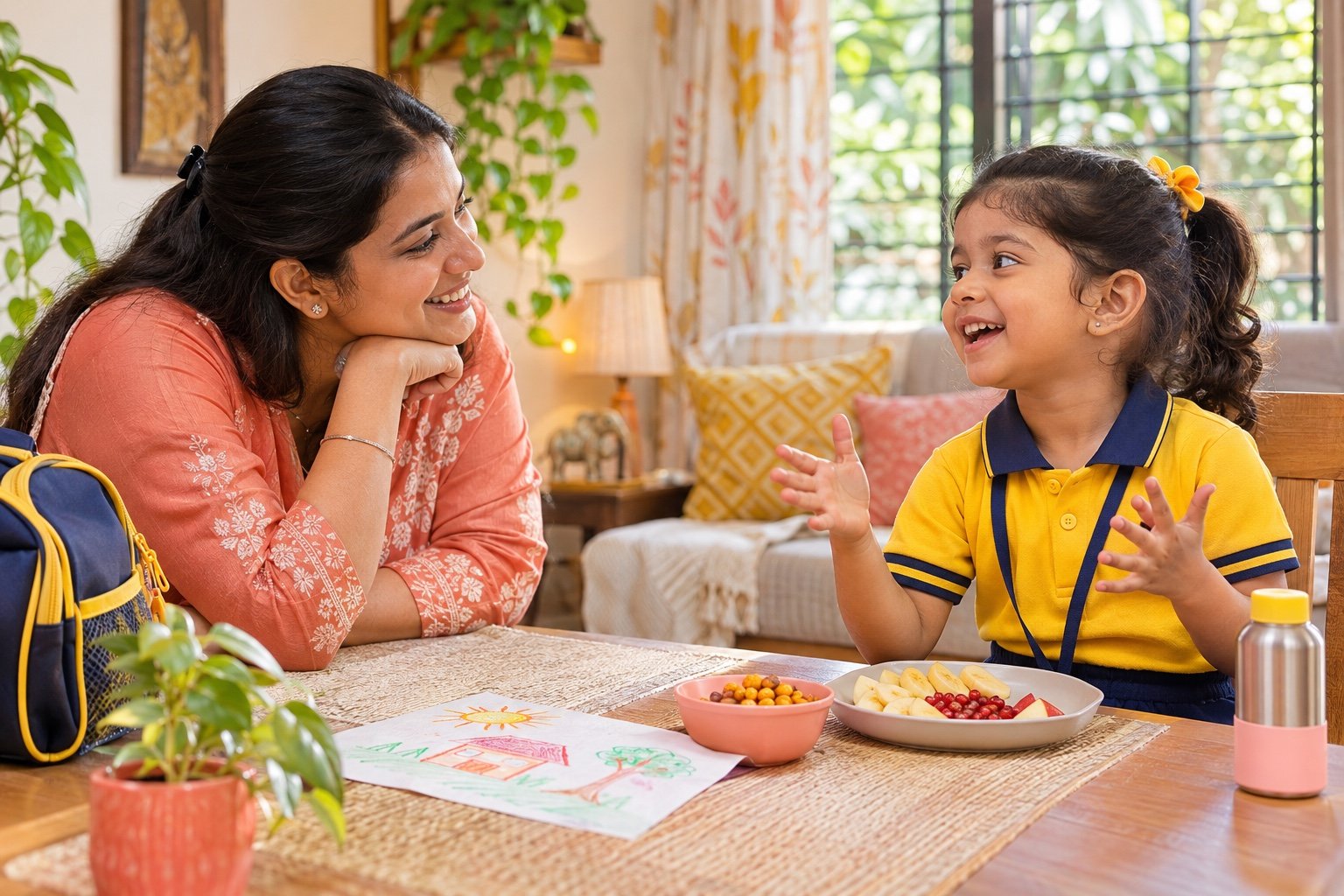
You wait all day to hear about preschool. Your child finally arrives and answers “fine”, “nothing” or “I don’t know”. That response rarely means the day contained nothing worth sharing. Preschoolers are still learning to recall events, put them in order and guess which detail an adult wants. At pickup they may also be hungry, tired or busy shifting from one world to another.
CDC’s four-year milestones include talking about at least one thing that happened during the day. That is different from giving a complete report on demand. NAEYC recommends open-ended questions that invite children to analyse, imagine and reflect, followed by attentive comments such as “Tell me more”. The aim is connection, not information extraction.
Why “How was school?” often gets “fine”
- It is too broad: “school” includes arrival, play, toilet, snack, stories, conflicts and goodbye.
- The child needs a cue: a drawing, lunch box or teacher’s name can help retrieve a memory.
- The transition is unfinished: the child may need food, movement and quiet before language.
- The expected answer is unclear: “good” may feel like the quickest correct response.
- Too many questions feel like a test: repeated prompting can make a child shut down or guess.
Begin with a welcome: eye contact, water, snack or a few minutes of play. Share one small detail from your own day—“I saw a very red bus”—without taking over the conversation. Then try one concrete prompt.
Questions about play and fun
- What made you laugh today?
- Which toy or activity did you choose first?
- If I came to your class for five minutes, what would you show me?
- What did you build, draw, sing or pretend today?
- Which game would you like to play again tomorrow?
- What was the silliest thing that happened?
Play questions are easy entry points because they ask for a visible action. If the child says “blocks”, respond with interest rather than another quiz: “Blocks! Tell me about what you made.”
Questions about friends and belonging
- Who was near you during play today?
- Did someone help you, or did you help someone?
- What game were other children playing?
- Was there a moment you wanted to join in?
- Who had an interesting idea today?
- Did anyone need a kind word or a hug?
“Who is your best friend?” can create pressure and may not fit preschool friendships, which often change by activity and day. Ask about actions and moments instead. If your child says nobody played with them, use our preschool friendship guide rather than immediately promising to fix everything.
Questions about feelings
- When did your body feel excited today?
- Was anything tricky, frustrating or confusing?
- Did you feel proud of something?
- Was there a moment you missed home?
- What helped you feel calm?
- If your day had a colour, what colour would it be—and why?
Accept the full range of answers. “I was sad when Papa left” does not require an instant correction. Try, “You missed Papa at goodbye. What happened next?” Naming feelings makes it safer to share them.
Questions about learning and curiosity
- What did the teacher read or tell you about?
- What new word, sound, number or idea did you notice?
- What question did you ask today?
- Did something surprise you?
- What was hard at first but easier later?
- Can you teach me one thing from your class?
“Teach me” changes the child from person-being-tested to expert. Let a partly remembered song or story stay imperfect. Curiosity matters more than correcting every fact during a connection moment.
Questions about routines and care
- What was the yummiest or newest thing at snack time?
- What job did you or a classmate do today?
- Where did you feel most comfortable in the classroom?
- Was there a time you needed an adult’s help?
- What should we pack or remember for tomorrow?
- What do you hope happens at preschool tomorrow?
Routine questions can reveal practical needs without asking “Did you eat?” five different ways. If food is a recurring concern, speak with the teacher and use our preschool lunch-box guide.
Use the three-part conversation method
Then pause. Young children need processing time. Silence is not failure, and eye contact need not be forced. Some children talk best side-by-side while drawing, travelling or building.
Choose the right moment
Pickup is not the only opportunity. Try after a snack, during bath time, while unpacking the bag, at dinner or before a story. A child who says nothing at 1 pm may spontaneously narrate the whole day at bedtime.
Put your phone aside for a few minutes. Avoid asking while simultaneously giving directions about shoes, uniform and handwashing. If mornings or transitions already bring conflict, the calm sequence in our clear-directions guide can keep the two conversations separate.
Help memory without supplying the answer
Use real cues: “I see blue paint on your sleeve. Tell me about the painting.” Look together at a class photo, artwork or the empty lunch box. Ask “What happened before that?” only when the child is relaxed.
Avoid leading questions such as “Did Riya push you again?” They can shape the answer. For an ordinary day, specific and open is the best combination: “Who was near the slide?” or “Tell me what happened at the slide.”
For multilingual children
Invite the child to answer in the language that feels easiest. Switching languages, using gestures or showing with toys still counts as communication. Do not demand an English report to prove that English was used at school. Retell the child’s message in a fuller sentence without turning it into a correction exercise.
If talking about daily events is difficult across all familiar languages, share examples with the teacher and see our speech and language guide.
If the answer worries you
Stay calm even if you feel shocked. Say, “Thank you for telling me” and use neutral prompts: “Tell me everything you remember” or “What happened next?” Do not repeatedly question, suggest details or promise secrecy. Write down the child’s words and contact the preschool promptly for a safety concern.
Seek appropriate medical, mental-health or child-protection help when the child describes harm, unsafe touch, serious bullying or fear. Urgent safety issues require immediate action. For non-urgent concerns, arrange a teacher conversation, compare observations and agree on a follow-up time.
What to avoid
- Asking all 30 questions in one sitting.
- Correcting grammar before responding to the story.
- Repeating a question until the child gives the answer you expected.
- Using a sibling’s detailed report as comparison.
- Reacting so strongly that the child starts protecting the adult from difficult news.
- Turning every funny story into a lesson or consequence.
The best after-school conversation is not the longest. It is the one that tells a child, “Your ideas and feelings are safe with me.”
Quick parent FAQs
Why does my preschooler say nothing happened?
They may be tired, hungry or unable to retrieve a whole day from a broad question. Connect first, then ask one concrete, open question about a person, activity or feeling.
When is the best time to ask about preschool?
Many children talk more after a snack, during play, in the bath or at bedtime. Choose a low-pressure moment and ask one question at a time.
What if my child shares something worrying?
Stay calm, listen and use neutral prompts such as “Tell me more”. Thank the child, record their words and contact the preschool promptly for a safety concern. Seek professional help when needed.